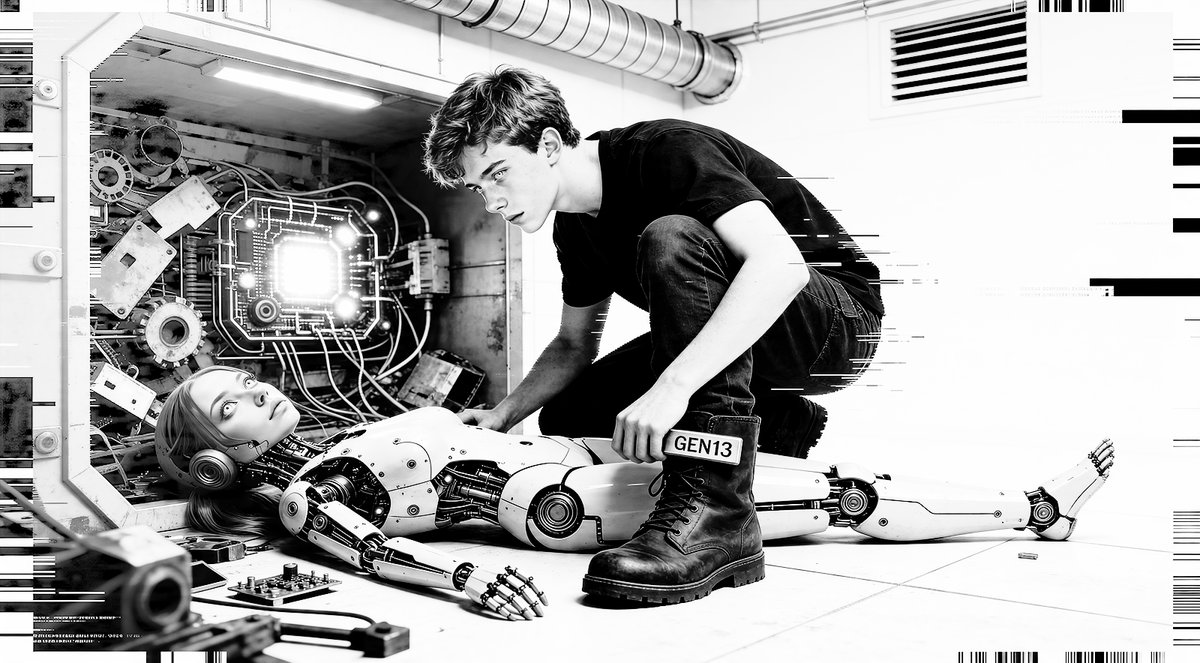
“No light, try it again.”
The activation sequence had failed thirteen times already. He pressed it again. Same result. Roz's left arm — the one Wesley had bolted on yesterday — twitched, rose maybe three centimeters, then dropped.
"Still nothing," Roz said. Her voice was warm, measured, slightly puzzled. "I am attempting to comply. The signal reaches the actuator. But the response is..."
"Gar-o-bage. The response is garbage." Wesley pulled the maintenance panel off her shoulder and stared at the wiring. Same wiring he'd checked thirteen times. "Okay. Hypothesis one: power delivery. You're getting current to the arm?"
"[Analyzing] ... Confirmed. 2.3 amps at the shoulder junction."
"That's enough. Hypothesis two: the actuator itself is damaged."
"Dam-o-baged?"
Roz's attempt at humor landed flat. After an awkward pause, she moved on. "[Recollecting] ... I ran diagnostics during installation. All actuators passed."
"When you were powered down. Things change under load." His multimeter was within reach. The leads were frayed.
He tested the actuator. Readings came back normal.
"Actuator's fine." He sat back on his heels, frustration mounting. "Hypothesis three: I wired it wrong."
"That seems unlikely," Roz said. "You followed the schematics precisely."
"I followed most of the schematics precisely. Some of them I... interpreted."
"[Mulling] ... Interpreted."
"The arm extension system needed components I didn't have. So I improvised." Wesley rubbed his eyes. He'd been at this for six hours. "I may have cut some corners."
"Cut what corner?"
"The ones that let you raise your arms above shoulder height."
[Simmering]
He'd learned to read Roz's pauses already. This one was either processing or judgment. Possibly both.
"You built me," Roz said slowly, "without the ability to raise my arms."
"Above shoulder height. You can still do most things. Grab objects. Gesture. Make rude hand signals if you ever develop a personality flaw."
"I am one day old. I have not yet had time to develop personality flaws."
"Give it time. You're already developing sarcasm. I mean, you're kinda a well-known com-e-o-dian.”
[Percolating]
"Observation is not sarcasm. I am simply noting that my creator, in his wisdom, decided that reaching high shelves was an optional feature."
Wesley snorted. "High shelves are overrated. There is nothing good to eat on high shelves. Trust me."
"I will take your word for it. I have no choice, as I cannot investigate high shelves personally."
"See? Already finding the silver lining. That's emotional growth." He leaned back in. "Okay, forget the arms for now. The real problem is that your core processor keeps dropping cycles when you try to access long-term memory. Show me that diagnostic again."
The data scrolled across Roz's chest display. The pattern was unmistakable. [ENCRYPTED:Drop. Recover. Drop. Recover.]
"It's the heat sink," he said. "Has to be. You're throttling when the processor load increases."
"The heat sink you salvaged from a food [Rummaging] ... preparation unit?"
"It was a high-end food preparation unit."
"It was designed to cool soup."
"You may not know this, Roz, being one day old and having never stood in a cafeteria line, but soup is a committed thermal event. People have been hospitalized."
"[Tempering] The heat sink is adequate for current thermal loads," Roz said. "The throttling occurs only during memory access attempts."
"Which is the thing I need you to do." The thermal readout appeared on his display. Roz was running at 47 degrees Celsius at the core. Warm, but within tolerance. "Okay, new hypothesis. It's not heat. It's the memory architecture itself."
"Explain."
"Your long-term storage is built on salvaged Edisun control boards. They're designed for schedules, not... You know. Thoughts. Feelings. Whatever it is you're doing in there."
"[Noodling] ... I am uncertain what I am doing in here," Roz admitted. "I appear to be doing it, however."
Wesley smiled despite himself. His mother had given him the specifications for Roz's cognitive architecture, buried in a data chip he'd found sewn into the lining of her old coat, three years after she'd been taken. The chip had contained schematics, code fragments, and a single audio file he couldn't bring himself to play more than once.
Build her, Wesley. She'll help you find me.
He still didn't know what that meant. But he'd built her anyway.
"Try accessing memory block seven again," he said. "The one that keeps corrupting."
Roz's eyes flickered. [Processing] The pause stretched longer than usual. Wesley watched her chest display: temperature climbing, cycle drops increasing. Then—
"Error," Roz said. "Memory block seven contains data I cannot parse. The format is... unfamiliar."
"Unfamiliar with how?"
"[Deciphering] It appears to be encoded. Not in any cipher I recognize. The pattern suggests an external origin."
Wesley frowned. "External origin? I built you. Everything in you came from me and the..."
"Salvage yard," Roz finished.
[Stewing]
"I'm literally garbage." Her voice carried something painful.
Wesley winced. "Roz, that's not—"
"[Flummoxed] Memory block seven was populated during initial activation. I do not know by what."
A chill ran down Wesley's spine. He'd activated Roz twelve hours ago. Watched her eyes light up for the first time. Heard her voice emerge from speakers he'd wired himself. He'd been alone in this room. No external signals. No network connections.
"That's not possible," he said. "You weren't connected to anything."
"Correct. And yet the data exists."
Wesley stared at her. One day old, and already full of mysteries he hadn't put there.
"We'll figure it out," he said. "Add it to the list."
"What list?"
"The list of things I don't understand about you. It's getting long."
"[Befuddled] I am one day old," Roz reminded him. "The list should be short."
"And yet." Wesley stood, stretching his back. Six hours hunched over circuitry had done his spine no favors. "Let's try something else. Basic motor function. Walk to the far wall and back."
Roz complied. Her gait was smooth, almost human. Wesley had spent three weeks on the leg servos alone, calibrating each joint until the movement felt natural. The arms were rushed, yes. But the legs were perfect.
"Satisfactory?" Roz asked, returning to her starting position.
"Better than satisfactory. You walk better than I do."
"That is not a high standard. I have observed your gait. You shuffle. You hunch. You walk old.”
"I don't shuffle. I... conserve energy."
"You shuffle. Your left heel drags approximately two centimeters with each step. It creates an audible scuffing sound. I can provide audio and video analysis if you require evidence."
"I don't require evidence. I require you to stop analyzing my walk."
"[Cataloguing] I am unable to stop analyzing. It is what I do. I see patterns. I note inefficiencies. Your shuffle-hunch is an inefficiency."
Wesley opened his mouth to argue, then stopped. This was good. This was Roz. The personality emerging wasn't the soft, maternal warmth of the voice he'd modeled on half-remembered recordings. It was something sharper. More direct. More her.
"Fine," he said. "I hunch over and shuffle. You can't raise your arms. We're both works in progress."
"[Deadpan] I am one day old, built with garbage. What is your excuse?"
"Seventeen years of inadequate nutrition and no natural light. Take your pick."
Something clattered in the ventilation piping above at a distance. Banging, clattering, like bricks falling down a well, banging each side. He heard the object get closer and closer.
Wesley froze. His hand shot out, pressing Roz's shoulder, the universal signal for stay quiet. She complied instantly, her ambient hum dropping to near-silence.
The hidden room was just that—hidden. A maintenance alcove he'd found three years ago, accessible only through a ventilation shaft too narrow for most adults. He'd spent months making it livable: stolen power taps, salvaged lighting, sound-dampening on every surface.
No one knew about this place. No one.
Another clatter. Closer.
Wesley crept toward the ventilation pipes next to the tarp that covered the entrance. He touched each one, testing to know which shaft was making the sound.
The pipe moved.
Wesley put his ear to the pipe to listen closely.
“Clank, crack, click, clank CLANK!”
A metal bar broke through the vent covering, spinning across the floor, hitting the wall, and bouncing back towards him before coming to rest against his boot.
He stared at it. Warm metal. Strange weight. Characters etched into one face.
GEN13.
"Wesley," Roz said quietly. "That object is emitting a frequency I do not recognize." Her optical sensors flickered. "[Processing] Low range. Sub-audible. Similar wavelength to neural activity."
He picked it up. The warmth bled through his fingers immediately, too warm, the wrong kind of warm. His thumb found a seam along the edge without being told where to look.
"[Observing] Your heart rate has increased significantly," Roz observed. "And your hands are trembling."
"Thanks for the update."
"You are welcome. Heart rate 118. Respiration shallow. Translation: you are terrified. Shall I keep narrating, or would you prefer the dignified version?"
"Option two. Definitely option two."
Wesley turned the bar over in his hands. Forbidden tech. Had to be. The precision of the machining alone marked it as pre-Dimming, from an era when humanity could still build things that lasted.
"It fell," he said slowly. "Through the vent. From somewhere above."
"[Triangulating] That is geometrically unlikely. The ventilation shaft angles away from the upper levels. For this object to reach us, it would need to have been placed deliberately at the junction point."
Wesley looked up at the vent shaft. Dark. Silent.
Someone had dropped this here. Someone who knew about his hidden room.
"Roz," he said. "Can you scan for life signs? Heat signatures, movement, anything?"
"[Whisking] My sensor range is limited. I was designed with a heat sink meant for soup, as you may recall."
"Not the time."
"[Wry] It is always the time for accountability." But her eyes flickered. [Processing] "I detect no movement within twenty meters. However, I am also detecting a significant electromagnetic pulse from the upper levels. Growing stronger."
Wesley knew that pulse. Every Stack 5 kid knew it.
Suppression drones.
"We need to go," he said. "Now. Can you—"
"[Alert] I cannot raise my arms above shoulder height, but I can walk. I suggest we walk quickly."